
As the summer heat retreats across East Asia, China transforms into a vast, kaleidoscopic canvas. Stretching across multiple climate zones—from the boreal taiga of the north and high-altitude Tibetan plateaus to historic imperial gardens and southern river valleys—the country's foliage season spans over three months, beginning in early September and continuing through December.
Whether you are seeking golden Siberian larch forests framed by snow-capped peaks, ancient desert poplars glowing against golden dunes, or centuries-old Buddhist temples enveloped in fiery red maples, here is your definitive guide to the six most spectacular fall foliage destinations in China and their precise peak viewing windows.
Kanas & Hemu, Xinjiang: Golden Birch Forests & Misty Alpine Valleys
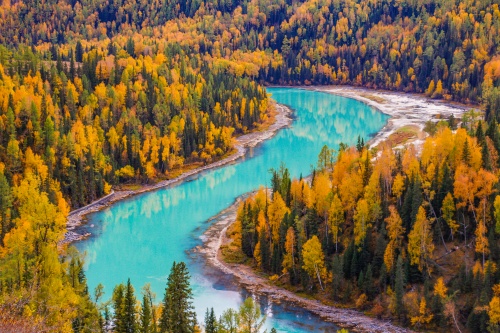
Peak Season: Mid–Late September
Key Scenery: Siberian birch forests, golden larches, alpine lakes, Tuvan wooden cabins
Located in the northern tip of Xinjiang near the Altay Mountains, the Kanas Nature Reserve and nearby Hemu Village offer China's earliest and most pristine autumn scenery. As temperatures drop in mid-September, dense forests of Siberian birch, aspen, and larch burst into vibrant shades of butter-yellow and amber gold, contrasting vividly against the turquoise glacial waters of Kanas Lake.
Mornings in Hemu Village are especially magical: woodsmoke drifts from rustic timber cabins of the indigenous Tuvan people while morning mist hovers over sweeping golden riverbanks, creating a tranquil, fairytale atmosphere that attracts landscape photographers from around the world.
Changbai Mountain, Jilin: Volcanic Slopes & Multi-Tiered Forest Canopy
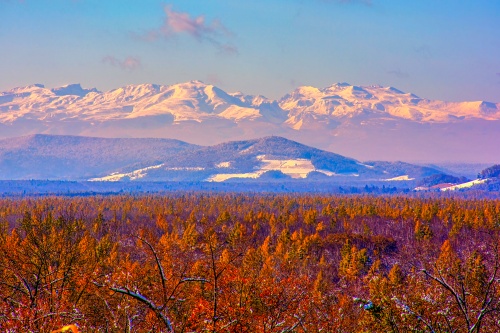
Peak Season: Late September to Early October
Key Scenery: Vertical vegetation zones, volcanic crater lake (Heaven Lake), birch-pine mixed forests
Towering on the border of Jilin Province in Northeast China, Changbai Mountain is an ancient stratovolcano celebrated for its dramatic vertical ecosystem. Because elevations range from low river valleys to alpine tundra over 2,500 meters high, autumn paints the mountain in distinct, colorful bands.
Broadleaf deciduous forests at lower elevations turn fiery scarlet and burnt orange, while mid-elevation Korean pines and golden Erman's birches frame rushing waterfalls and geothermal hot springs. The visual contrast between colorful mountain flanks, jagged volcanic ridges, and the deep blue water of Heaven Lake (Tianchi) makes late September the premier window to visit.
Ejin Banner, Inner Mongolia: Golden Populus Euphratica in the Desert
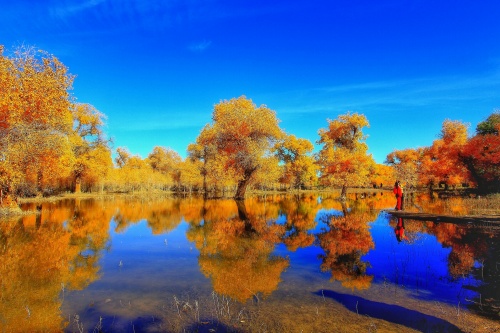
Peak Season: October 1 – October 15
Key Scenery: Ancient desert poplar forests (Populus euphratica), shimmering desert oases, Badain Jaran dunes
In the western deserts of Inner Mongolia, the Ejin Populus Euphratica Forest (Huyanglin) is one of only three remaining ancient desert poplar ecosystems on Earth. Known as "living fossils" capable of surviving extreme drought and saline soils, these resilient trees turn a blazing, uniform gold for just two brief weeks every October.
The most iconic viewpoints are located along the numbered bridges crossing the Heihe River, where golden tree canopies reflect mirrored images across calm desert waters before fading into the vast sand dunes of the Badain Jaran Desert.
Miyaluo, Western Sichuan: Alpine Larches & Snow-Capped Glacial Valleys
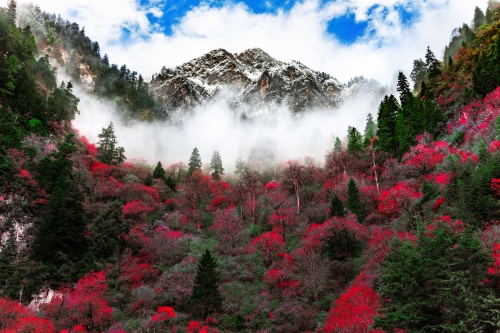
Peak Season: Mid–Late October
Key Scenery: Alpine red birch, Chinese larch, snow-covered mountain peaks, Tibetan-Qiang stone towers
Covering over 3,000 square kilometers in the Aba Tibetan and Qiang Autonomous Prefecture of Western Sichuan, Miyaluo is one of the largest designated autumn scenic areas in China. Located along the eastern edge of the Qinghai-Tibet Plateau, the region combines high-altitude autumn colors with rich Tibetan and Qiang cultural heritage.
During mid-to-late October, vast mountain slopes become an intricate mosaic of crimson maples, golden larches, and green fir trees, set against glacial streams and traditional stone watchtowers. Its proximity to Mount Siguniang and Bipenggou makes it a standout highlight on Western Sichuan overland routes.
Fragrant Hills (Xiangshan), Beijing: Imperial Pavilions Enveloped in Crimson
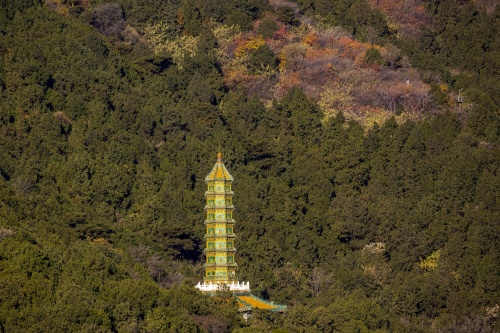
Peak Season: Mid-October to Early November
Key Scenery: Smoke trees (Cotinus coggygria), trident maples, imperial gazebos, classical architecture
For travelers staying in the capital, Fragrant Hills Park (Xiangshan) in northwestern Beijing is China's most celebrated classical autumn landmark. Cultivated since the Jin and Qing Dynasties as an imperial retreat, the park's rugged hillsides are forested with tens of thousands of smoke trees (Cotinus coggygria / Huanglu) and maple varieties.
When autumn frosts arrive in late October, the entire valley turns a deep, fiery crimson. Climbing to the park's highest summit, Xianglu Peak (Incense Burner Peak), rewards visitors with sweeping panoramic views of crimson-draped hills juxtaposed against historic royal pavilions and the distant Beijing skyline.
Mount Qixia, Nanjing: Ancient Buddhist Temples Framed by Fiery Red Maples
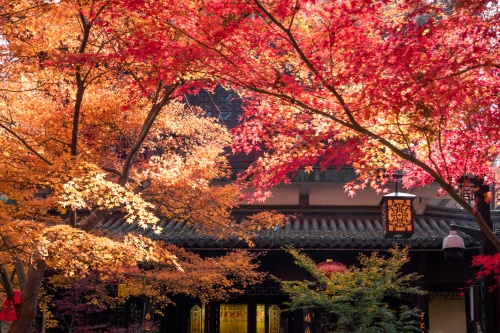
Peak Season: Mid-November to Early December
Key Scenery: Japanese red maples, ginkgo trees, historic Buddhist grottoes, classical Jiangnan pavilions
Known traditionally as the premier autumn destination in South China, Mount Qixia in Nanjing brings the fall foliage season to a grand, poetic finale. Unlike the dry, crisp foliage of the northern forests, Qixia's autumn is defined by lush Jiangnan garden aesthetics and deep cultural reverence.
Ancient stone stupas, millennium-old Buddhist grottoes, and historic temple courtyards of Qixia Temple are framed by glowing red maples and towering golden ginkgo trees. The mild southern climate allows the colors to peak later in the year, remaining vibrant well into early December.
China Autumn Foliage Calendar: Peak Dates at a Glance
|
Destination |
Province / Region |
Dominant Foliage Types |
Peak Viewing Window |
|
Kanas & Hemu |
Xinjiang (Northwest) |
Siberian Birch, Larch, Aspen |
Mid–Late September |
|
Changbai Mountain |
Jilin (Northeast) |
Korean Pine, Erman's Birch, Maple |
Late Sep – Early Oct |
|
Ejin Banner |
Inner Mongolia (North) |
Populus Euphratica (Desert Poplar) |
Oct 1 – 15 |
|
Miyaluo & Bipenggou |
Sichuan (Southwest) |
Red Birch, Alpine Larch, Maple |
Mid–Late October |
|
Fragrant Hills (Xiangshan) |
Beijing (North) |
Smoke Tree (Huanglu), Trident Maple |
Mid-Oct – Early Nov |
|
Mount Qixia |
Nanjing, Jiangsu (East) |
Japanese Maple, Chinese Ginkgo |
Mid-Nov – Early Dec |
Frequently Asked Questions: Planning a China Autumn Foliage Trip
Q: When is the overall best month to see autumn leaves in China?
A: October is the overall peak month for autumn foliage across most of China. Northern and high-altitude destinations (like Kanas and Changbai Mountain) peak in late September, central and western regions (like Ejin and Sichuan) peak throughout October, and southern destinations (like Nanjing and Hangzhou) reach full vibrance in November.
Q: Which destination is best for photographing golden leaves versus red maples?
A: For expansive golden colors, Kanas in Xinjiang and Ejin Banner in Inner Mongolia are the premier choices, while Fragrant Hills in Beijing and Mount Qixia in Nanjing offer the most iconic fiery red foliage. Kanas and Ejin are dominated by birch and desert poplar forests that turn pure gold, whereas Beijing and Nanjing feature dense plantings of smoke trees and Japanese red maples.
Q: Is traveling during the October Golden Week holiday recommended for foliage viewing?
A: While early October offers prime foliage conditions for northern destinations, traveling during the October 1–7 National Day Golden Week requires advance planning. Booking private transportation, reserving park permits well in advance, or scheduling departures directly after October 7 allows travelers to enjoy peak foliage with fewer crowds.